 2025, Vol. 37





南海东部油田储层中砂岩占比较高,连通性好,采用天然水驱能量开发可取得较好的开发效果[1-2]。然而矿场实践表明,受岩性、断层和储层非均质性等的影响,天然水驱能量开发模式的驱替效果不佳,油藏采收率偏低,需由天然水驱能量开发模式转为天然水驱能量和人工注水相结合的复合能量开发模式。在开发模式转变后,井网部署需要考虑的因素增加,老井网的适应性会逐渐变差,需对注采井网进行合理的调整[3-6]。
合理的油水井数比是指在井底流动压力和开发总井数一定的条件下,能够获得最高产液量的采油井和注水井的数量之比。在井网调整中,油水井数比是注水油田开发的关键指标之一,可影响油田井网部署、水驱开发生产合理指标的制定[7-9]。目前,水驱开发油田合理油水井数比的计算方法较多,通常基于注采平衡条件、经济极限条件进行推导。童宪章等[10]、方凌云等[11]、李留仁等[12]基于物质平衡原理,通过吸水、采油指数法,建立了注采平衡条件下的合理油水井数比计算模型并形成图版。邹存有等[13]、贾自立等[14]考虑了注采比、低渗油藏启动压力梯度等因素,建立了注采不平衡、油水井间地层压力不同时油田合理油水井数比的计算模型。杨志军等[15]、侯建锋等[16]、于成龙等[17]考虑了经济因素以及注采平衡理论公式,通过经济界限论证了水驱油田的合理井网密度和注采井数比。俞启泰[18]、齐与峰等[19]、耿站立[20]等通过注采井数比、井网密度与水驱油田采收率的变化关系,研究了合理油水井数比在矿场实践中的界限[18-20]。随着研究的进一步深入,研究人员综合考虑经济因素、理论公式、数值模拟等方法,对不同类型、不同开发阶段油藏的合理油水井数比、合理注采参数等进行了计算与论证[21-23]。
在实际生产中,由于水驱油田往往存在边、底水等天然能量的补充,生产井产量和地层压力会受到影响[24]。因受边水能量的影响,注水开发油田内的注采关系更为复杂[25-27],未考虑边水能量因素的传统计算方法对合理油水井数比的计算结果适用性较差。海上注水油田在开发过程中,受平台数量、井槽数量的作业空间限制,总井数通常在长时间内为固定数量,矿场通常需要采用油井转注水井的方式增加注水井数,从而改变油水井数比,完善注采井网、补充地层能量。在油田总井数固定的情况下,采用边水供给和注水并存的复合能量驱替方式开发油田,不同开发阶段的油水井数比会显著影响油藏地层压力保持水平以及油田的最大日产液量,需精细调整油水井数比,以确保油田的长期稳定生产并提高最终采收率。
本文在考虑边水能量对油田合理油水井数比的影响下,将边水能量等效为注水井,在注采平衡条件下依据极值定理,在总井数固定的条件下,建立油田合理油水井数比的计算新模型,讨论边水驱油藏合理油水井数比、合理地层压力等关键指标,以期为相似边水驱油田开发提供一定理论指导。
1 合理油水井数比计算新模型水油井数比Rwo、油水井数比Rwo的计算公式分别为
| $ R_{\mathrm{wo}}=\frac{n_{\mathrm{w}}}{n_{\mathrm{o}}}=\frac{n_{\mathrm{w}}}{n_{\mathrm{t}}-n_{\mathrm{w}}} $ | (1) |
| $ R_{\mathrm{ow}}=\frac{n_{\mathrm{o}}}{n_{\mathrm{w}}}=\frac{n_{\mathrm{o}}}{n_{\mathrm{t}}-n_{\mathrm{o}}} $ | (2) |
式中:nt,no和nw分别为油田总井数、采油井数和注水井数,口。
当平均含水率为fw时,平均单井日产液量的地下体积可表示为
| $ q_{\mathrm{L}}=J_{\mathrm{L}}\left(P_{\mathrm{R}}-P_{\mathrm{wf}}\right)\left[\left(1-f_{\mathrm{w}}\right) \frac{B_{\mathrm{o}}}{\rho_{\mathrm{o}}}+\frac{f_{\mathrm{w}} B_{\mathrm{w}}}{\rho_{\mathrm{w}}}\right] $ | (3) |
油田日产液量的地下体积为
| $ Q_{\mathrm{L}}=n_{\mathrm{o}} J_{\mathrm{L}}\left(P_{\mathrm{R}}-P_{\mathrm{wf}}\right)\left[\left(1-f_{\mathrm{w}}\right) \frac{B_{\mathrm{o}}}{\rho_{\mathrm{o}}}+\frac{f_{\mathrm{w}} B_{\mathrm{w}}}{\rho_{\mathrm{w}}}\right] $ | (4) |
式中:QL和qL分别为油田日产液量和单井平均日产液量的地下体积,m3;JL为油井产液指数,t/(d·MPa);PR和Pwf分别为地层压力和井底流压,MPa;ρw和ρo分别为水和油的密度,t/m3;Bw和Bo分别为地层水和油的体积系数。
油田日注水量为注水井和边水注入量之和,本文将边水能量等效为注水井(图 1),因此油田总日注入量地下体积、注水井平均单井日注水量地下体积和天然水体日注水量分别为
| $ q_{\mathrm{inj}}=n_{\mathrm{w}} I_{\mathrm{w}}\left(P_{\mathrm{inj}}-P_{\mathrm{R}}\right) \frac{B_{\mathrm{w}}}{\rho_{\mathrm{w}}} $ | (5) |
| $ q_{\mathrm{e}}=I_{\mathrm{e}}\left(P_{\mathrm{e}}-P_{\mathrm{R}}\right) $ | (6) |
| $ Q_{\mathrm{inj}}=q_{\mathrm{inj}}+q_{\mathrm{e}}=n_{\mathrm{w}} I_{\mathrm{w}}\left(P_{\mathrm{inj}}-P_{\mathrm{R}}\right) \frac{B_{\mathrm{w}}}{\rho_{\mathrm{w}}}+I_{\mathrm{e}}\left(P_{\mathrm{e}}-P_{\mathrm{R}}\right) $ | (7) |
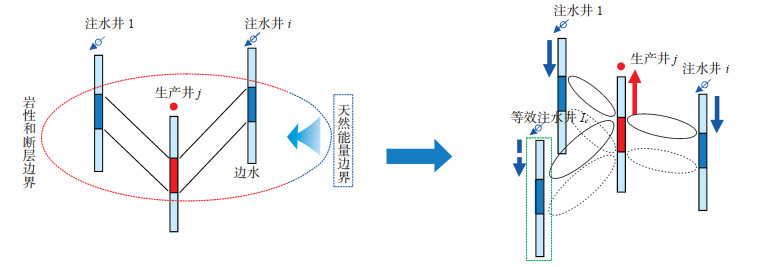
|
下载原图 图 1 边水能量等效模型 Fig. 1 Equivalent model diagram of edge water energy |
式中:Pinj和Pe分别为注水井注入压力和天然水体边界压力,MPa;JL,Iw和Ie分别为油井产液指数、水井吸水指数和边水水侵指数,t/(d·MPa)。
油田总注采比RIP、注水井的注采比rip和水侵量的注采比rep分别为
| $ R_{\mathrm{IP}}=\frac{Q_{\mathrm{inj}}}{Q_{\mathrm{L}}}=\frac{\left(q_{\mathrm{inj}}+q_{\mathrm{e}}\right)}{Q_{\mathrm{L}}} $ | (8) |
| $ r_{\mathrm{ip}}=\frac{q_{\mathrm{inj}}}{Q_{\mathrm{L}}} $ | (9) |
| $ r_{\mathrm{ep}}=\frac{q_{\mathrm{e}}}{Q_{\mathrm{L}}} $ | (10) |
由式(1)与式(2)联立得
| $ n_{\mathrm{w}}=\frac{n_{\mathrm{t}} R_{\mathrm{wo}}}{1+R_{\mathrm{wo}}} $ | (11) |
将式(4)和式(7)代入式(8)得
| $ \begin{gathered} R_{\mathrm{IP}} n_{\mathrm{o}} J_{\mathrm{L}}\left(P_{\mathrm{R}}-P_{\mathrm{wf}}\right)\left[\left(1-f_{\mathrm{w}}\right) \frac{B_{\mathrm{o}}}{\rho_{\mathrm{o}}}+\frac{f_{\mathrm{w}} B_{\mathrm{w}}}{\rho_{\mathrm{w}}}\right]= \\ n_{\mathrm{w}} I_{\mathrm{w}}\left(P_{\mathrm{inj}}-P_{\mathrm{R}}\right) \frac{B_{\mathrm{w}}}{\rho_{\mathrm{w}}}+I_{\mathrm{e}}\left(P_{\mathrm{e}}-P_{\mathrm{R}}\right) \end{gathered} $ | (12) |
令
| $ a_1=R_{\mathrm{IP}}\left[\left(1-f_{\mathrm{w}}\right) \frac{B_{\mathrm{o}}}{\rho_{\mathrm{o}}}+f_{\mathrm{w}} \frac{B_{\mathrm{w}}}{\rho_{\mathrm{w}}}\right] $ | (13) |
| $ a_2=\frac{B_{\mathrm{w}}}{\rho_{\mathrm{w}}} $ | (14) |
将式(12)进行简化,地层压力PR的表达式为
| $ P_{\mathrm{R}}=\frac{\left(n_{\mathrm{t}} a_2 I_{\mathrm{w}} P_{\mathrm{inj}}+I_{\mathrm{e}} P_{\mathrm{e}}\right) R_{\mathrm{wo}}+\left(n_{\mathrm{t}} a_1 J_{\mathrm{L}} P_{\mathrm{wf}}+I_{\mathrm{e}} P_{\mathrm{e}}\right)}{\left(n_{\mathrm{t}} a_2 I_{\mathrm{w}}+I_{\mathrm{e}}\right) R_{\mathrm{wo}}+\left(n_{\mathrm{t}} a_1 J_{\mathrm{L}}+I_{\mathrm{e}}\right)}=\frac{A_1 R_{\mathrm{wo}}+A_2}{A_3 R_{\mathrm{wo}}+A_4} $ | (15) |
令
| $ A_1=n_{\mathrm{t}} a_2 I_{\mathrm{w}} P_{\mathrm{inj}}+I_{\mathrm{e}} P_{\mathrm{e}} $ | (16) |
| $ A_2=n_{\mathrm{t}} a_1 J_{\mathrm{L}} P_{\mathrm{wf}}+I_{\mathrm{e}} P_{\mathrm{e}} $ | (17) |
| $ A_3=n_{\mathrm{t}} a_2 I_{\mathrm{w}}+I_{\mathrm{e}} $ | (18) |
| $ A_4=n_{\mathrm{t}} a_1 J_{\mathrm{L}}+I_{\mathrm{e}} $ | (19) |
将式(15)代入式(4),油田日产液量为
| $ Q_{\mathrm{L}}=\frac{n_{\mathrm{t}}}{1+R_{\mathrm{wo}}} J_{\mathrm{L}}\left(\frac{A_1 R_{\mathrm{wo}}+A_2}{A_3 R_{\mathrm{wo}}+A_4}-P_{\mathrm{wf}}\right)\left[\left(1-f_{\mathrm{w}}\right) \frac{B_{\mathrm{o}}}{\rho_{\mathrm{o}}}+f_{\mathrm{w}} \frac{B_{\mathrm{w}}}{\rho_{\mathrm{w}}}\right] $ | (20) |
其中,令
| $ a_3=\left(1-f_{\mathrm{w}}\right) \frac{B_{\mathrm{o}}}{\rho_{\mathrm{o}}}+f_{\mathrm{w}} \frac{B_{\mathrm{w}}}{\rho_{\mathrm{w}}} $ | (21) |
| $ B_1=P_{\mathrm{wf}} A_3^2-A_1 A_3 $ | (22) |
| $ B_2=2 P_{\mathrm{wf}} A_3 A_4-2 A_2 A_3 $ | (23) |
| $ B_3=A_1 A_4-A_2\left(A_3+A_4\right)+P_{\mathrm{wf}} {A_4}^2 $ | (24) |
对式(20)求导,则QL对Rwo的导数为
| $ \frac{\mathrm{d} Q_{\mathrm{L}}}{\mathrm{~d} R_{\mathrm{wo}}}=a_3 n_{\mathrm{t}} J_{\mathrm{L}} \frac{B_1 {R_{\mathrm{wo}}}^2+B_2 R_{\mathrm{wo}}+B_3}{\left(1+R_{\mathrm{wo}}\right)^2\left(A_3 R_{\mathrm{wo}}+A_4\right)^2} $ | (25) |
通过极值法求解,令
| $ B_1 {R_{\mathrm{wo}}}^2+B_2 R_{\mathrm{wo}}+B_3=0 $ | (26) |
因此,使油田产液量最大的合理水油井数比Rwo可表示为
| $ R_{\mathrm{wo}}=\frac{-B_2 \pm \sqrt{{B_2}^2-4 B_1 B_3}}{2 B_1} $ | (27) |
最终,合理油水井数比Rwo为
| $ R_{\mathrm{ow}}=\frac{2 B_1}{-B_2 \pm \sqrt{B_2{ }^2-4 B_1 B_3}} $ | (28) |
根据南海东部开发油藏实践,边水能量充足的中高渗油藏往往具有波及范围大、单井控制面积大、驱油效率高、最终采收率高等特征。因此,对于海上注水开发的边水油藏,在总井槽固定的条件下,充分利用边水能量并合理调整注采井网是高效开发的关键。
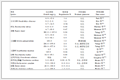
珠江口盆地新近系珠江组A油藏为海相三角洲沉积体系的岩性构造油藏,主要发育水下分流河道、河口坝沉积微相,受断层、构造、岩性多种因素控制。A油藏东部和南部发育岩性尖灭,北部大部分被断层断开,西北部与北部有边水能量补充。储层原始地层压力为25.1 MPa,平均渗透率为557 mD,平均有效孔隙度为20.7%,地面原油密度为0.88 t/m3,地下原油黏度为5.1 mPa·s,原油体积系数为1.06,地层饱和压力为1.04 MPa,井槽共计24个,其中生产油井19口、注水井5口。目前生产动态参数如 表 1所示、井位如图 2所示,地层压力系数为0.81,利用天然能量采用欠压开采。
|
下载CSV 表 1 珠江口盆地A油藏生产参数 Table 1 The parameters of reservoir A in the Pearl River Mouth Basin |
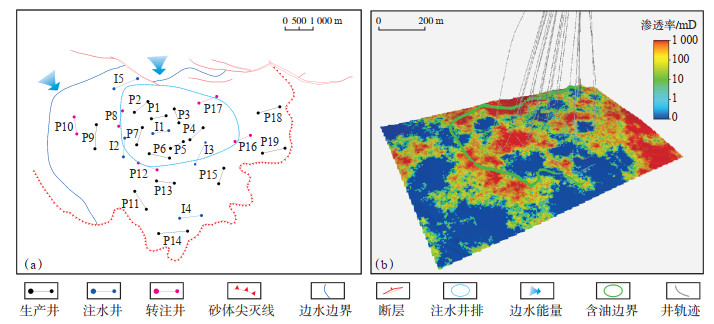
|
下载原图 图 2 珠江口盆地A油藏井位(a)及渗透率(b)分布 Fig. 2 Well location(a)and permeability distribution(b)map of reservoir A in the Pearl River Mouth Basin |
由表 1可看出,19口采油井平均产液指数为186.5 t/(d·MPa),平均井底流压为14.5 MPa。5口注水井平均吸水指数为626.1 t/(d·MPa),平均注入压力为25.0 MPa。边水日侵入量为230 2.0 m3/d,注入边界压力为25.1 MPa。通过公式(27)和公式(14)计算出合理油水井数比为1.97,合理地层压力为21.27 MPa,其他合理注采生产参数如表 2所示。油藏现阶段油水井数比为3.8,因此需转注3~4口采油井,进一步降低油水井数比,提高油藏日产液量与采油速度。
|
|
下载CSV 表 2 合理注采系统参数计算结果 Table 2 The calculation results of the parameters of reasonable injecting-producing system |
利用数值模拟软件构建珠江口盆地A油藏数值模型,模型网格数为260×192×28,x,y方向网格Δ x= Δy=50 m,z方向网格Δ z=0.5 m,孔隙度为0.12%~0.25%,油藏中部深度为2 550 m,生产参数如表 1所示。基于目前井网,对5口生产井P12,P16,P17,P08,P10依次转注。预测至2034年底,不同注采井网下的油藏数值模拟结果如表 3所示。
|
|
下载CSV 表 3 不同井网下的数值模拟计算结果 Table 3 Numerical simulation results under different well patterns |
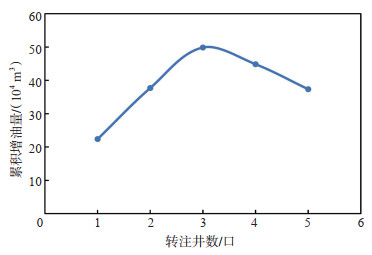
随着采油井转注数量增加,边水能量供给占比逐渐减小,当油藏日产液量接近最大值时,边水侵入量下降平缓(图 3)。当油水井数比为2.0时(转注3口油井),油藏累增油量最大(图 4),此时最大产液量为20 100 m3/d、水侵量为1 562 m3/d、累增油量为49.9×104 m3,与新模型理论计算结果接近。
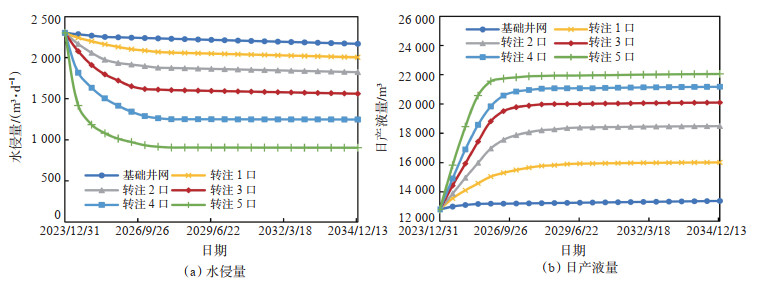
|
下载原图 图 3 不同井网下的水侵量与日产液量 Fig. 3 Water influx and daily liquid production under different well patterns |
|
下载原图 图 4 不同井网下的累增油量 Fig. 4 Cumulative incremental oil under different well patterns |
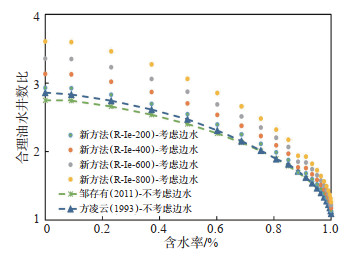
受岩性、断层和储层非均质性等的影响,不同油藏水侵量存在差异。假设水体无限大,在水侵量分别为200 m3/(d·MPa),400 m3/(d·MPa),600 m3/(d·MPa),800 m3/(d·MPa)时,分析考虑边水水侵和不考虑边水水侵时[11, 13]油水井数比的变化规律(图 5)。
|
下载原图 图 5 不同水侵系数下的合理油水井数比 Fig. 5 Reasonable oil-water well ratio under different water invasion coefficients |
当水侵量为200 m3/(d·MPa)时,新方法与传统方法计算结果接近,油水井数比随含水率的增加而降低,通过油井转注,改善油田开发效果;当水侵量大于200 m3/(d·MPa)时,水侵量越大,开发初期新方法与传统方法的计算结果差异大。由于新方法考虑边水能量补充,将边水等效为注水井,水侵量越大,等效注水井注入能力越强,因此新方法合理油水井数比计算结果更大。随着进一步开发,油田在中后期采取油井转注的策略,随着注水井增加,油水井数比降低,油藏压力恢复,边水侵入量下降,当含水率超过90% 时,计算结果与传统计算结果接近。因此,此类油田开发初期可依托天然能量开发,随着含水率的上升,通过油井转注,逐步降低油水井数比,改善开发效果。
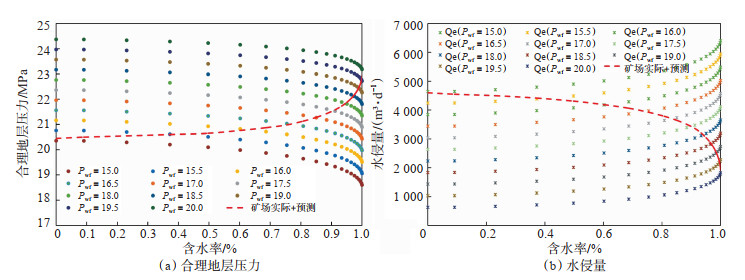
2.2 地层压力、边水侵入分析假设油藏一直保持注采平衡,随着开发过程中含水率逐渐增大,合理油水井数比呈下降趋势(图 5)。此时,相应条件下的合理地层压力逐渐减小,边水侵入量逐渐增大(图 6)。
|
下载原图 图 6 不同井底流压下的地层压力和水侵量 Fig. 6 Reasonable formation pressure and water influx under different bottom hole pressures |
在开发初期,油藏充分利用天然能量,通过较大的生产压差实现复合能量驱替的良好开发效果。在开发中后期,逐步降低合理油水井数比调整注采井网,优化注采压力进一步提高地层压力,释放油田产能。
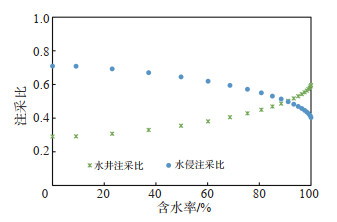
2.3 合理注采比分析矿场生产中油水井的注采比是关键开发指标之一,油田开发保持注采平衡(总注采比为1),但受天然水体供给影响,油水井的合理注采比不为1。当水侵系数为1 000 t/(d·MPa)时,注水井、天然水侵合理注采比如图 7所示。在含水率小于10% 的开发初期,天然水侵的注采比约为71%;随着进入特高含水期,合理油水井数比逐渐减小,注水井的合理注采比增大,注水井的能量供给占比大于50%,因此在开发初期,可以利用天然能量,采用较多的油井保障开发效果;在高含水时期,保持注水井的能量供给占主导,通过提液维持油藏高采油速度。
|
下载原图 图 7 不同开发阶段油水井和水侵注采比 Fig. 7 Injection-production ratio of wells and water-invasion at different stages |
(1) 在注采平衡条件下,推导了边水驱油藏合理油水井数比的计算公式。边水水侵系数对合理油水井数比的影响最为显著,本文方法相较于传统不考虑天然能量补充的方法,计算结果更加可靠。
(2) 海上平台井槽数量有限,为实现单井控制储量大和油井数量多,建议海上边水油藏在开发前期充分利用天然能量,保持油井较大生产压差;在开发中后期,根据水淹综合认识,实施油井转注,提高注采井数比,从而满足高速高效开发需求。
(3) 珠江口盆地A油藏现阶段油水井数比为3.8,合理油水井数比为1.97,需转注3~4口油井,此时将满足高产液量和天然能量高利用率。
| [1] |
谢明英, 戴宗, 孙晓娜, 等. 海上强水驱砂岩油田产液结构优化研究与实践. 中外能源, 2019, 24(9): 50-54. XIE Mingying, DAI Zong, SUN Xiaona, et al. Research and practice of structure optimization of fluid production in offshore strong water flooding sandstone oilfield. Sino-Global Energy, 2019, 24(9): 50-54. |
| [2] |
李振君, 李晓玲. 南海东部油田高产稳产开发实践. 中国海上油气(地质), 2002, 16(2): 54-60. LI Zhenjun, LI Xiaoling. The practice of development with high and stable production for Nahai East Oilfields. China Offshore Oil and Gas, 2002, 16(2): 54-60. |
| [3] |
聂海峰, 谭蓓, 谢爽, 等. 应用矢量井网优化小型油藏注水井位. 岩性油气藏, 2013, 25(3): 123-126. NIE Haifeng, TAN Bei, XIE Shuang, et al. Applying vector well pattern to optimize the flooding well site of small reservoir. Lithologic Reservoirs, 2013, 25(3): 123-126. DOI:10.3969/j.issn.1673-8926.2013.03.022 |
| [4] |
陶帅, 郝永卯, 周杰, 等. 透镜体低渗透岩性油藏合理井网井距研究. 岩性油气藏, 2018, 30(5): 116-123. TAO Shuai, HAO Yongmao, ZHOU Jie, et al. Reasonable pattern well spacing deployment of lens lithologic reservoirs with low permeability. Lithologic Reservoirs, 2018, 30(5): 116-123. DOI:10.12108/yxyqc.20180514 |
| [5] |
张吉磊, 罗宪波, 张运来, 等. 提高稠油底水油藏转注井注水效率研究. 岩性油气藏, 2019, 31(4): 141-148. ZHANG Jilei, LUO Xianbo, ZHANG Yunlai, et al. Improving water injection efficiency of transfer injection well in heavy oil bottom water reservoir. Lithologic Reservoirs, 2019, 31(4): 141-148. DOI:10.12108/yxyqc.20190415 |
| [6] |
徐伟, 缪云, 闫正和, 等. 南海东部海相砂岩油藏开发井网适应性定量评价. 石油地质与工程, 2023, 37(6): 90-96. XU Wei, MIAO Yun, YAN Zhenghe, et al. Quantitative evaluation of well pattern adaptability for marine sandstone reservoirs in the eastern South China Sea. Petroleum Geology and Engineering, 2023, 37(6): 90-96. |
| [7] |
蔡晖, 屈丹, 陈民锋. 组合井网储量动用规律及水平井加密合理技术策略: 以渤海HD油田为例. 岩性油气藏, 2021, 33(4): 147-155. CAI Hui, QU Dan, CHEN Minfeng. Reserve producing law of combined well pattern and technology strategy of horizontal well infilling: A case study from HD oilfield in Bohai Sea. Lithologic Reservoirs, 2021, 33(4): 147-155. DOI:10.12108/yxyqc.20210416 |
| [8] |
张俊, 黄琴, 王月杰, 等. 基于断层井网组合模式下的极限注采比确定方法. 石油化工应用, 2023, 42(5): 11-14. ZHANG Jun, HUANG Qin, WANG Yuejie, et al. Method for determining the limit injection production ratio based on the combined pattern of fault well networks. Petrochemical Industry Application, 2023, 42(5): 11-14. |
| [9] |
张意超, 陈民锋, 屈丹, 等. X油田特低渗透油藏井网加密效果预测方法. 岩性油气藏, 2020, 32(1): 144-151. ZHANG Yichao, CHEN Minfeng, QU Dan, et al. Prediction method of well pattern infilling effect for ultra-low permeability reservoir in X oilfield. Lithologic Reservoirs, 2020, 32(1): 144-151. DOI:10.12108/yxyqc.20200116 |
| [10] |
陈元千, 吕恒宇, 傅礼兵, 等. 注水开发油田加密调整效果的评价方法. 油气地质与采收率, 2017, 24(6): 60-64. CHEN Yuanqian, LYU Hengyu, FU Libing, et al. Evaluation method of infill adjustment effect for waterflooding development oilfields. Petroleum Geology and Recovery Efficiency, 2017, 24(6): 60-64. |
| [11] |
方凌云, 万新德. 高含水中后期砂岩油山的强化注水. 石油勘探与开发, 1993, 20(2): 47-55. FANG Lingyun, WAN Xinde. Enhanced water injection in sandstone oil fields with high water content in the later stage. Petroleum Exploration and Development, 1993, 20(2): 47-55. |
| [12] |
李留仁, 袁士义, 胡永乐, 等. 合理注采井数比与合理压力保持水平的确定. 西安石油大学学报(自然科学版), 2011, 26(3): 59-61. LI Liuren, YUAN Shiyi, HU Yongle, et al. Determination of reasonable ratio of injectors to producers and reasonable pressure maintenance level. Journal of Xi'an Shiyou University (Natural Science Edition), 2011, 26(3): 59-61. |
| [13] |
邹存友, 常毓文, 王国辉, 等. 水驱开发油田合理油水井数比的计算. 石油勘探与开发, 2011, 38(2): 211-214. ZOU Cunyou, CHANG Yuwen, WAN Guohui, et al. Calculation on a reasonable production-injection well ratio in waterflooding oil fields. Petroleum Exploration and Development, 2011, 38(2): 211-214. |
| [14] |
贾自力, 高文君, 赵晓萍, 等. 水驱油田合理井网密度和注采井数比的确定. 新疆石油地质, 2005, 26(3): 562-564. JIA Zili, GAO Wenjun, ZHAO Xiaoping, et al. Determination of reasonable well spacing density and injection to production well ratio in waterflooding field. Xinjiang Petroleum Geology, 2005, 26(3): 562-564. |
| [15] |
杨志军, 杜旭林, 曹仁义, 等. 复杂小断块采收率及经济合理井网密度模型. 断块油气田, 2020, 27(1): 80-84. YANG Zhijun, DU Xulin, CAO Renyi, et al. Recovery ratio of complex small fault blocks and economic reasonable well pattern density model. Fault-Block Oil & Gas Field, 2020, 27(1): 80-84. |
| [16] |
侯建锋, 胡亚斐, 刘畅, 等. 水驱油藏经济极限和合理井网密度确定方法. 新疆石油天然气, 2018, 14(3): 53-57. HOU Jianfeng, HU Yafei, LIU Chang, et al. A new approach to estimate economic limit and reasonable well spacing density for water flooding reservoirs. Xinjiang Oil & Gas, 2018, 14(3): 53-57. |
| [17] |
于成龙, 李慧敏, 赵敏, 等. 水驱油田井网加密合理井数的计算方法研究. 岩性油气藏, 2011, 23(1): 111-113. YU Chenglong, LI Huimin, ZHAO Min, et al. Research on the calculation method of reasonable number of wells for well network infiltration in water drive oilfield. Lithologic Reservoirs, 2011, 23(1): 111-113. DOI:10.3969/j.issn.1673-8926.2011.01.021 |
| [18] |
俞启泰. 计算水驱砂岩油藏合理井网密度与极限井网密度的一种方法. 石油勘探与开发, 1986, 13(4): 49-54. YU Qitai. A method for calculating the reasonable and extreme well density in a water flooding sandstone reservoir. Petroleum exploration and development, 1986, 13(4): 49-54. |
| [19] |
齐与峰, 李炎波. 采注井数比对水驱采收率影响研究. 石油勘探与开发, 1995, 22(11): 52-54. QI Yufeng, LI Yanbo. Research on the influence of the ratio of production and injection wells on water drive recovery. Petroleum Exploration and Development, 1995, 22(11): 52-54. |
| [20] |
耿站立, 安桂荣, 周文胜, 等. 水驱砂岩油藏开发调整全过程井网密度与采收率关系. 中国海上油气, 2015, 27(6): 57-62. GENG Zhanli, AN Guirong, ZHOU Wensheng, et al. Relation between well pattern density and recovery factor through the whole period of development adjusting in sandstone reservoir. China Offshore Oil and Gas, 2015, 27(6): 57-62. |
| [21] |
赵向宏. 水驱小油藏合理采液速度、合理井网密度及布井方式研究. 石油勘探与开发, 1994, 21(1): 75-79. ZHAO Xianghong. A study on proper recovery rate, well pattern and well spacing of a small oil reservoir with active water drive. Petroleum exploration and development, 1994, 21(1): 75-79. |
| [22] |
金一, 唐恩高, 张健, 等. 海上油田聚合物驱极限井网密度研究: 以渤海S油田为例. 复杂油气藏, 2022, 15(3): 84-90. JIN Yi, TANG Engao, ZHANG Jian, et al. Study on limit well pattern density of polymer flooding in offshore oilfield: A case study of Oilfield S in Bohai Bay. Complex Hydrocarbon Reservoirs, 2022, 15(3): 84-90. |
| [23] |
曲海旭, 许必锋, 王作乾, 等. 哈萨克斯坦Z油田中高含水期井网加密调整潜力评价. 科学技术与工程, 2019, 19(12): 123-130. QU Haixu, XU Bifeng, WANG Zuoqian, et al. Potential evaluation of infill well pattern adjustment in middle and high water cut period of Z Oilfield in Kazakhstan. Science Technology and Engineering, 2019, 19(12): 123-130. |
| [24] |
李晓平, 袁淋, 罗诚, 等. 边水推进对水平井产量的影响. 岩性油气藏, 2014, 26(5): 107-112. LI Xiaoping, YUAN Lin, LUO Cheng, et al. Effect of edge water incursion on productivity of horizontal well. Lithologic Reservoirs, 2014, 26(5): 107-112. DOI:10.3969/j.issn.1673-8926.2014.05.020 |
| [25] |
吴雅丽, 敖文君, 张宁, 等. 渤海B油田边水对注水井调剖调驱效果的影响研究. 非常规油气, 2020, 7(3): 55-59. WU Yali, AO Wenjun, ZHANG Ning, et al. Study on the influence of side water in b oilfield on profile control and flooding effects of water injection wells. Unconventional Oil & Gas, 2020, 7(3): 55-59. |
| [26] |
孟智强, 葛丽珍, 祝晓林, 等. 气顶边水油藏气/水驱产油量贡献评价方法. 岩性油气藏, 2022, 34(5): 162-170. MENG Zhiqiang, GE Lizhen, ZHU Xiaolin, et al. Oil production contribution evaluation method of gas/water drive in gascap and edge-water reservoirs. Lithologic Reservoirs, 2022, 34(5): 162-170. DOI:10.12108/yxyqc.20220514 |
| [27] |
张保康, 徐国瑞, 铁磊磊, 等. "堵水+调剖"工艺参数优化和油藏适应评价实验: 以渤海SZ36-1油田为例. 岩性油气藏, 2017, 29(5): 155-161. ZHANG Baokang, XU Guorui, TIE Leilei, et al. Optimization of technological parameters and evaluation of reservoir adaptation by water plugging and profile control: A case from Bohai SZ36-1 oil field. Lithologic Reservoirs, 2017, 29(5): 155-161. DOI:10.3969/j.issn.1673-8926.2017.05.019 |