 2025, Vol. 37





2. 中海油研究总院有限责任公司,北京 102209;
3. 中国石油大学(华东)石油工程学院,山东 青岛 266580
2. CNOOC Research Institute Co., Ltd., Beijing, 102209, China;
3. School of petroleum engineering, China University of Petroleum(East China), Qingdao, 266580, Shandong, China
疏松砂岩胶结作用弱,海上开发具有单井注入量大、注入速度快的特征[1]。海上井组示踪剂测试表明,注水井周围易在不同注采方向上形成多条高渗条带,即大孔道[2-3];同时由于海上油田注入速度快,大孔道内极易产生高速非达西渗流[4]。大孔道的存在可导致注入水的突进及大量的无效水循环,严重影响了油田的开发效果,所以大孔道的精准识别是目前高含水油田高效开发的关键任务[5-7]。
不稳定试井作为地层参数解释的关键手段,已有相关学者进行了研究并将其应用于大孔道的定量识别中[8-10]。史有刚等[11]假设地层中存在2条对称于井筒的大孔道,采用类似裂缝的处理方式对大孔道进行表征,建立了相应的试井模型并将其应用于实际生产井的大孔道识别中,证实了该试井模型在大孔道识别中的可应用性。李成勇等[12]考虑了大孔道在井两侧不对称的情况,建立了大孔道试井模型,对两侧不对称大孔道的发育压力动态特征进行了分析。Feng等[13]将大孔道处理为平板模型,结合智能优化算法形成大孔道解释方法,应用于胜利油田。谷建伟等[14]考虑大孔道发育的径向非均质性,提出了一种考虑大孔道与非大孔道区域相互耦合的注入井径向模型,通过注入井井底压力变化特征判断大孔道的发育面积和发育倍数。曾杨等[15]以垂直裂缝井模型为基础,采用有限差分法对模型进行数值求解,建立聚合物驱大孔道油藏试井解释模型。综上所述,不稳定试井可作为大孔道识别的有效方法,目前大孔道的不稳定试井模型已得到一定发展,但主要聚焦于对称大孔道与非对称大孔道2种情况,难以描述井周围分布多条大孔道的情况,且并未考虑大孔道内高速非达西渗流影响。
因此,本文拟建立考虑高速非达西渗流的发育多条大孔道的注水直井不稳定试井半解析模型,来实现对注水井发育多条大孔道及大孔道内高速非达西渗流的刻画,并针对大孔道数量、导流能力及高速非达西渗流等对试井曲线的影响规律进行研究,以期为注水井大孔道的定量识别提供一定借鉴。
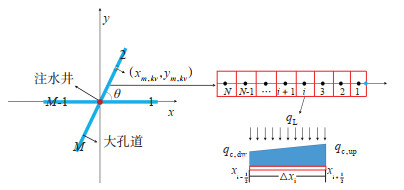
1 模型建立 1.1 物理模型大孔道是与注水井相连的高渗条带,图 1为发育多条大孔道的注水直井物理简化模型,直井位于平面无限大的地层中心,每条大孔道贯穿整个储层且储层厚度为h。为了方便求解,进行如下假设:油藏为单重介质,大孔道为与注水井相连的矩形高渗条带;油藏储层与大孔道内均为单相水渗流,油藏储层内为达西渗流,大孔道内存在高速非达西渗流;忽略重力及温度变化的影响[16]。
|
下载原图 图 1 发育多条大孔道的注水直井示意图 Fig. 1 Diagram of vertical injection well with multi flow channels |
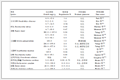
为便于数学模型的建立和求解,对无因次变量进行定义(表 1)。
|
下载CSV 表 1 无因次参数 Table 1 Dimensionless parameters |
基于上述假设,单相水达西渗流油藏渗流模型为[17]
| $ \frac{1}{r} \frac{\partial}{\partial r}\left(r \frac{k_{\mathrm{m}}}{\mu} \frac{\partial p_{\mathrm{m}}}{\partial r}\right)=\frac{\phi c_{\mathrm{tm}} \partial p_{\mathrm{m}}}{\partial t} $ | (1) |
注入线源内边界条件为
| $ \lim\limits _{r \rightarrow 0}\left(\frac{2 \mathsf{π} k_{\mathrm{m}} h}{\mu B} r \frac{\partial p_{\mathrm{m}}}{\partial r}\right)=-\hat{q} $ | (2) |
式中:$\hat{q}$ 为线源流量,$\mathrm{cm}^{2} / \mathrm{s}$。
无限大外边界条件为
| $ p_{\mathrm{m}}(r \rightarrow \infty)=0 $ | (3) |
基于上述无因次量,进行无因次化和Laplace变换可得拉式空间中线源数学模型[18-19]为
| $ \frac{1}{r_{\mathrm{D}}} \frac{\partial}{\partial r_{\mathrm{D}}}\left(r_{\mathrm{D}} \frac{\partial \bar{p}_{\mathrm{mD}}}{\partial r_{\mathrm{D}}}\right) =s \bar{p}_{\mathrm{mD}} $ | (4) |
| $ \lim\limits _{r_{\mathrm{D}} \rightarrow 0}\left(r_{\mathrm{D}} \frac{\partial \bar{p}_{\mathrm{mD}}}{\partial r_{\mathrm{D}}}\right) =\overline{\hat{q}}_{\mathrm{D}} $ | (5) |
| $ \bar{p}_{\mathrm{mD}}\left(r_{\mathrm{D}} \rightarrow \infty\right) =0 $ | (6) |
式中:s为Laplace变量。
结合边界条件,可得线源引起的压力为
| $ \bar{p}_{\mathrm{mD}}=\overline{\hat{q}}_{\mathrm{D}}\left[K_{0}\left(r_{\mathrm{D}} \sqrt{f(s)}\right)\right] $ | (7) |
其中:$f(s)=s, r_{\mathrm{D}}=\sqrt{\left(x_{\mathrm{D}}-x_{\mathrm{wD}}\right)^{2}+\left(y_{\mathrm{D}}-y_{\mathrm{wD}}\right)^{2}}$
式中:$x_{\mathrm{wD}}, y_{\mathrm{wD}}$ 为线源的无因次空间坐标。
1.2.2 大孔道渗流模型采用Barree-Conway模型表征高速非达西渗流[20-21]
| $ k_{\mathrm{F}}=k_{\mathrm{F} 0}\left(k_{\mathrm{mr}}+\frac{1-k_{\mathrm{mr}}}{1+\frac{\rho v}{\mu \tau}}\right) $ | (8) |
式中:$k_{\mathrm{mr}}$ 为最小渗透率与原始渗透率比值;$v$ 为流速,$\mathrm{cm} / \mathrm{s}; \rho$ 为水相密度,$\mathrm{g} / \mathrm{cm}^{3}$。
基于无因次量,该高速非达西渗流模型可表示为
| $ k_{\mathrm{F}}=k_{\mathrm{F} 0} \delta_{\mathrm{F}} $ | (9) |
其中:$\delta_{\mathrm{F}}=k_{\mathrm{mr}}+\frac{1-k_{\mathrm{mr}}}{1+F_{\mathrm{ND}} q_{\mathrm{cD}}}$。
如图 1所示,直井周围发育M条大孔道,将大孔道近似处理为矩形高渗区域。由于大孔道内不均匀的流量分布,考虑高速非达西渗流后,大孔道的导流能力沿大孔道是变化的。采用离散方法对大孔道进行处理,每条大孔道被分割成N个离散段。结合其对称性,针对i-th大孔道段,忽略大孔道内的弹性变化量,结合无因次量和Laplace变换,可得拉式空间中大孔道渗流模型为[22-23]
| $ \frac{\partial^{2} \bar{p}_{\mathrm{FD}}^{k+1}}{\partial x_{\mathrm{D}}^{2}}+\left.\frac{2}{C_{\mathrm{FDi}}\left(q_{\mathrm{cD}}^{k}\right)} \frac{\partial \bar{p}_{\mathrm{mD}}}{\partial y_{\mathrm{D}}}\right|_{y=\frac{w_{\mathrm{FD}}}{2}}=0 $ | (10) |
| $ \frac{\partial \bar{p}_{F D}^{k+1}}{\partial x_{\mathrm{D}}}=-\frac{2 \mathsf{π}}{C_{\mathrm{FDi}}\left(q_{\mathrm{cD}}^{k}\right)} \bar{q}_{\mathrm{cD}\left(x_{\mathrm{D}}\right)}^{k+1} $ | (11) |
| $ \left.\frac{\partial \bar{p}_{\mathrm{mD}}}{\partial y_{\mathrm{D}}}\right|_{y_{\mathrm{D}}=\frac{w_{\mathrm{FD}}}{2}}=-\mathsf{π} \bar{q}_{\mathrm{LDi}}^{k+1} $ | (12) |
式中:$C_{\mathrm{FDi}}$ 为i-th段大孔道导流能力;$q_{\mathrm{LDi}}$ 为i-th段大孔道无因次流量密度;$k+1$ 为第$k+1$ 迭代步。
对式与式进行联立,进而进行积分,得
| $ \begin{gather*} \frac{\partial \bar{p}_{\mathrm{FD}}^{k+1}}{\partial x_{\mathrm{D}}}-\left.\frac{\partial \bar{p}_{\mathrm{FD}}^{k+1}}{\partial x_{\mathrm{D}}}\right|_{x_{\mathrm{D}}=x_{\mathrm{Di}-\frac{1}{2}}}=\frac{2 \mathsf{π}}{C_{\mathrm{FDi}}\left(q_{c D}{ }^{k}\right)} \bar{q}_{\mathrm{LDi}}^{k+1} . \\ \left(x_{\mathrm{D}}-x_{\mathrm{Di}-\frac{1}{2}}\right) \end{gather*} $ | (13) |
对式与式进行联立,得沿大孔道方向的流量分布,可表示为
| $ \bar{q}_{\mathrm{cD}\left(x_{\mathrm{D}}\right)}^{k+1}=\bar{q}_{\mathrm{cDi}-\frac{1}{2}}^{k+1}-\bar{q}_{\mathrm{LDi}}^{k+1}\left(x_{\mathrm{D}}-x_{\mathrm{Di}-\frac{1}{2}}\right) $ | (14) |
对式在i-th离散段内进行积分,得到i-th离散段内压降为
| $ \begin{gather*} \Delta \bar{p}_{\mathrm{FDi}}{ }^{k+1}=\bar{p}_{\mathrm{FDi}-\frac{1}{2}}{ }^{k+1}-\bar{p}_{\mathrm{FDi}+\frac{1}{2}}{ }^{k+1}= \\ \frac{2 \mathsf{π}}{C_{\mathrm{FDi}}\left(q_{c D}{ }^{k}\right)} \int\limits_{x_{\mathrm{Di}+\frac{1}{2}}}^{x_{\mathrm{Di}+\frac{1}{2}}} \bar{q}_{\mathrm{cDi}-\frac{1}{2}}{ }^{k+1}-\bar{q}_{\mathrm{LDi}}{ }^{k+1}\left(x_{\mathrm{D}}-x_{\mathrm{Di}-\frac{1}{2}}\right) \mathrm{d} x_{\mathrm{D}} \end{gather*} $ | (15) |
对各离散段的压降进行累加,得到井筒到i-th离散段的压降公式(式16),该公式能够处理高速非达西渗流引起的大孔道导流能力非均匀分布的问题,且形式简单,易于程序实现。
| $ \begin{align*} \bar{p}_{\mathrm{wD}}-\bar{p}_{\mathrm{FDi}}^{k+1}= & 2 \mathsf{π}\left[\sum\limits_{n=1}^{i-1} \frac{\Delta x_{\mathrm{Dn}}}{C_{\mathrm{FDn}}\left(q_{\mathrm{cD}}{ }^{k}\right)}+\frac{\Delta x_{\mathrm{Di}}}{2 C_{\mathrm{FDi}}\left(q_{\mathrm{cD}}{ }^{k}\right)}\right] \sum\limits_{m=1}^{N} \bar{q}_{\mathrm{LDm}}{ }^{k+1} \Delta x_{\mathrm{Dm}} \\ & -2 \mathsf{π} \sum\limits_{j=1}^{i-1}\left[\sum\limits_{n=j}^{i} \frac{\Delta x_{\mathrm{Dn}}}{C_{\mathrm{FDn}}\left(q_{\mathrm{cD}}{ }^{k}\right)}-\frac{\Delta x_{\mathrm{Dj}}}{2 C_{\mathrm{FDj}}\left({q_{\mathrm{cD}}}^{k}\right)}-\frac{\Delta x_{\mathrm{Di}}}{2 C_{\mathrm{FDi}}\left(q_{\mathrm{cD}}{ }^{k}\right)}\right] \Delta x_{\mathrm{Dj}} \bar{q}_{\mathrm{LDj}}{ }^{k+1}-\frac{2 \mathsf{π}}{C_{\mathrm{FDi}}\left(q_{\mathrm{cD}}{ }^{k}\right)} \frac{\Delta x_{\mathrm{Di}}{ }^{2}}{8} \bar{q}_{\mathrm{LDi}}{ }^{k+1} \end{align*} $ | (16) |
式中:$p_{\mathrm{wD}}$ 为不考虑表皮系数和井筒储存的井底压力;$\Delta x_{\mathrm{Di}}$ 为i-th段大孔道长度。
1.2.3 耦合求解结合线源解(式7)和叠加原理,第k个大孔道第v个离散段无因次压力为
| $ \bar{p}_{\mathrm{FD} k v}=\sum\limits_{i=1}^{M} \sum\limits_{j=1}^{N} \bar{q}_{\mathrm{FD} i, j} \int_{x_{\mathrm{D}, j}}^{x_{\mathrm{D}, j+1}}\left[K_{0}\left(\sqrt{\left(x_{\mathrm{D} \mathrm{~m}, k, v}-\alpha\right)^{2}+\left[y_{\mathrm{D} \mathrm{~m}, k, v}-\alpha \cot \theta_{i}\right]^{2}} \sqrt{f(s)}\right)\right] \mathrm{d} \alpha $ | (17) |
式中:$x_{\mathrm{Dm}, k, v}, y_{\mathrm{Dm}, k, v}$ 是指第$k$ 个大孔道第$v$ 个离散段中心点坐标。
模型中存在$M$ 条大孔道,每条大孔道被分为N段,则共计存在$M \times N+1$ 个未知数,包括$M \times N$ 个$q_{\mathrm{FD}}$ 及1个井底流压$p_{\mathrm{wD}}$;同时,模型具有$M \times N+1$ 个方程,包括$M \times N$ 个大孔道压力解(式16)及1个边界条件(式18),基于上述方程实现压力动态求解。
| $ Q_{\mathrm{wD}}=\sum\limits_{i=1}^{M} \sum\limits_{j=1}^{N} q_{\mathrm{FDi}, \mathrm{j}} \Delta x_{\mathrm{Di}, \mathrm{j}}=1 / s $ | (18) |
在此基础上考虑表皮系数和井筒储存
| $ \bar{p}_{\mathrm{D}}=\frac{s \bar{p}_{\mathrm{wD}}+S}{s+C_{\mathrm{D}} s^{2}\left(s \bar{p}_{\mathrm{wD}}+S\right)} $ | (19) |
式中:$S$ 为表皮因子;$P_{\mathrm{D}}$ 为考虑表皮系数和井筒储存的无因此井底压力。
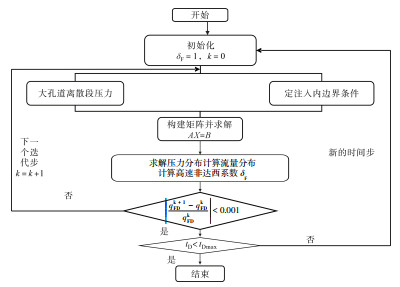
当考虑高速非达西渗流时,大孔道的导流能力$\left(C_{\mathrm{FD}}\right)$ 是大孔道内流体流量($q_{\mathrm{cD}}$)的函数,上述模型为非线性模型,可引入迭代法进行求解,具体求解步骤为:(1)输人计算基本参数;(2)开始新的时间步,设置迭代步$k=0$,并将各离散段高速非达西系数$\delta_{\mathrm{F}}$ 初始化为1;(3)进人迭代步中,根据各个离散段的高速非达西系数$\delta_{\mathrm{F}}$,计算各离散段的导流能力,对未知量进行求解;(4)计算各大孔道各个离散段内的压力及流量分布,更新各个离散段的高速非达西系数$\delta_{\mathrm{F}}$;(5)对2个迭代步之间的误差进行判断,如果满足精度要求则进人下一时间步,如果不满足要求,令$k=k+1$,执行步骤3及步骤4直至精度满足要求进人下一时间步;(6)开始一个新的时间步,重复执行步骤2至步骤5直至所有时间步计算完成(图 2)。
|
下载原图 图 2 压力动态求解流程图 Fig. 2 Flow chart of pressure dynamic solution |
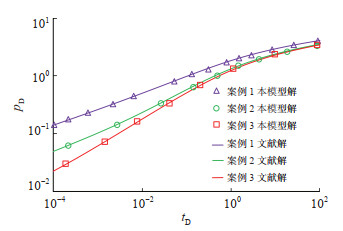
将本文模型与Poe等[24]的模型进行对比,对具有非均匀导流能力的大孔道压力动态特征进行验证。假设油藏为单重介质,模型发育2条对称大孔道,每条大孔道被均分为4段($\Delta x_{\mathrm{D} 1}=\Delta x_{\mathrm{D} 2}=\Delta x_{\mathrm{D} 3}=\Delta x_{\mathrm{D} 4}= 0.25$),每段大孔道的导流能力如表 2所示。由图 3可知,本文模型解与Poe等[24]的解一致性好,说明本文模型的解可以应用于具有非均匀导流能力的大孔道的压力动态求解。
|
|
下载CSV 表 2 大孔道导流能力参数 Table 2 Parameters of flow channel conductivity capacity |
|
下载原图 图 3 变导流能力的大孔道动态压力特征验证 Fig. 3 Pressure transient validation of flow channel with variable diverting capacity |
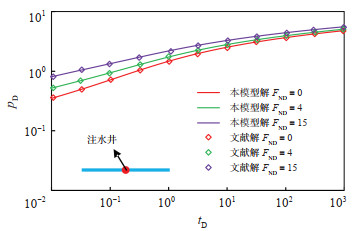
大孔道内的高流速可产生高速非达西渗流,影响注水井的生产动态。建立发育2条对称大孔道的模型,初始无因次导流能力CFD = 5,设置kmr = 0,将本文模型简化为Forchheimer模型,与Guppy文献[25]中压力动态解进行对比验证[25]。由图 4可看出,考虑高速非达西渗流,本文模型与Guppy模型[25]的压力动态计算结果一致性好,说明本文压力动态求解模型适用于存在高速非达西渗流的大孔道的压力动态求解。
|
下载原图 图 4 存在高速非达西渗流的大孔道动态压力解 Fig. 4 Pressure transient validation of flow channel with high-velocity non-Darcy flow |
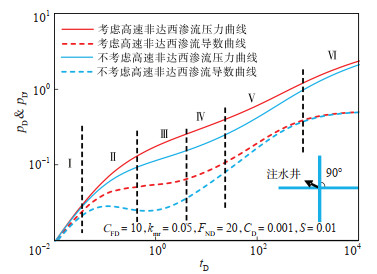
图 5为发育4条大孔道的注水直井的不稳定压力动态典型曲线。根据不稳定压力及压力导数特征,典型曲线可划分为以下6个流动阶段:井储段,压力与压力导数曲线为一条重合直线;过渡段;双线性流,压力导数曲线斜率为1/4;线性流段,压力导数曲线斜率为1/2;大孔道干扰段,压力导数曲线的斜率为1/2~1;径向流段,压力导数为0.5。多条大孔道的存在可导致双线性流段、线性流段及大孔道干扰段的产生,是大孔道识别的重要标志。
|
下载原图 图 5 不稳定压力动态典型曲线 Fig. 5 Typical curves of unstable pressure transient |
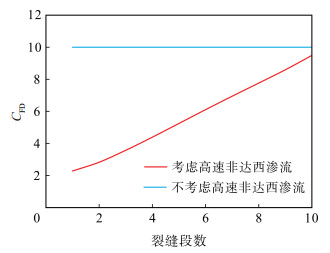
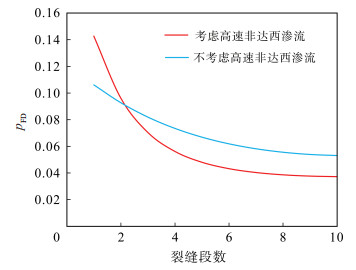
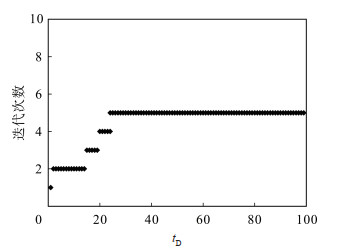
大孔道内高速非达西渗流主要对早期阶段的压力解产生影响,考虑高速非达西渗流后,早期压力及压力导数曲线均明显向上移动,当tD = 0.001时,考虑高速非达西渗流无因次压力增加了55%,这是因为高速非达西渗流产生额外的生产压差,大孔道内渗流阻力增大,考虑大孔道内高速非达西渗流可实现更加准确的大孔道参数解释。考虑高速非达西渗流后,近井端大孔道导流能力出现明显下降;同时可以发现考虑高速非达西渗流后,近井端大孔道无因次压力明显增大,无因次压力沿大孔道下降更快(图 6,图 7)。设置100个时间步进行模拟,442次迭代完成计算,表明迭代计算是处理高速非达西渗流的必要方法(图 8)。
|
下载原图 图 6 大孔道导流能力对比 Fig. 6 Comparison of diversion capacity of flow channels |
|
下载原图 图 7 大孔道内压力分布对比 Fig. 7 Pressure distribution of flow channel |
|
下载原图 图 8 高速非达西模型迭代次数 Fig. 8 Iteration number of high-velocity non-Darcy model |
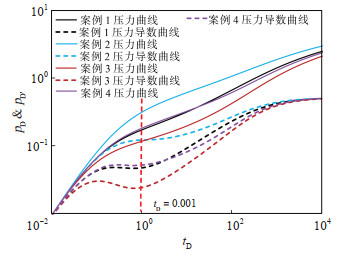
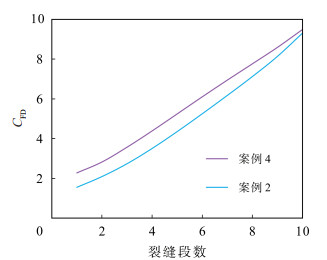
设计4个案例对大孔道数量的影响进行分析,案例1:发育2条大孔道,不考虑高速非达西渗流;案例2:发育2条大孔道,考虑高速非达西渗流;案例3:发育4条大孔道,不考虑高速非达西渗流;案例4:发育4条大孔道,考虑高速非达西渗流(图 9)。由图 9可看出,大孔道数量增加,注水井流动能力增强,双线性流、线性流及大孔道干扰段曲线明显下降,对比案例1和案例3,当tD=0.001时,随着大孔道由2条变为4条,无因次压力由0.17下降至0.12,下降了29.4%。同时,随着大孔道增多,高速非达西渗流的影响程度有所减小,当tD=0.001时,随着大孔道由2条增加至4条,高速非达西渗流引起的压力增幅由89% 下降至55%,这是因为大孔道增多,每条大孔道内流体流量减小,高速非达西渗流作用减弱,由图 10可看出,4条大孔道情况下高速非达西渗流导致的导流能力伤害程度相对2条大孔道更小,大孔道内导流能力更大。
|
下载原图 图 9 大孔道数量对压力动态曲线的影响 Fig. 9 Influence of the numbers of flow channels on pressure transient curves |
|
下载原图 图 10 案例2与案例4大孔道导流能力分布(tD = 0.001) Fig. 10 Diversion capacity of flow channels of Case 2 and Case 4(tD = 0.001) |
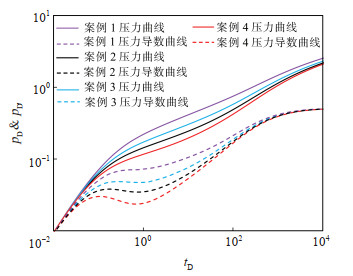
大孔道导流能力是大孔道评价的关键参数,设计4个案例对大孔道导流能力的影响进行分析,案例1∶CFD=5,考虑高速非达西渗流;案例2∶CFD=5,不考虑高速非达西渗流;案例3∶CFD=10,考虑高速非达西渗流;案例4∶CFD=10,不考虑高速非达西渗流。由图 11可看出,随着大孔道导流能力增大,注水井流动阻力减小,考虑与不考虑高速非达西渗流情况下,双线性流、线性流及大孔道干扰段压力及压力导数曲线均向下明显移动。
|
下载原图 图 11 大孔道导流能力对压力动态曲线的影响 Fig. 11 Influence of diversion capacity of flow channels on pressure transient curves |
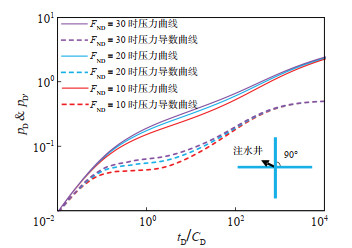
Barree-Conway高速非达西渗流模型由高速非达西数(FND)和最小渗透率比值(kmr)2个参数构成。高速非达西数越大,高速非达西渗流导致的大孔道导流能力下降越严重,由图 12可看出,随着FND由10增加至30,大孔道流动阶段压力曲线逐渐上升,高速非达西渗流的影响加剧。
|
下载原图 图 12 高速非达西数对生产动态的影响 Fig. 12 Influence of high-velocity non-Darcy on production dynamics |
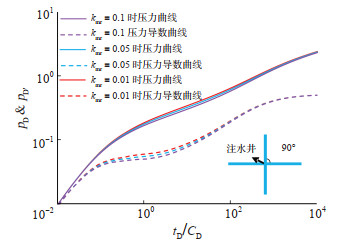
由图 13可看出,kmr的增大意味着考虑高速非达西对导流能力的伤害程度减小,当kmr=1时,Barree-Conway高速非达西渗流模型变为达西渗流模型。随着kmr由0.01增大至0.10,早期压力及压力导数曲线出现下降,高速非达西渗流的影响减小。
|
下载原图 图 13 高速非达西最小渗透率比值对压力动态的影响 Fig. 13 Influence of minimum permeability ratio of high-velocity non-Darcy on pressure transient |
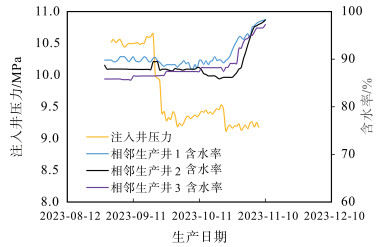
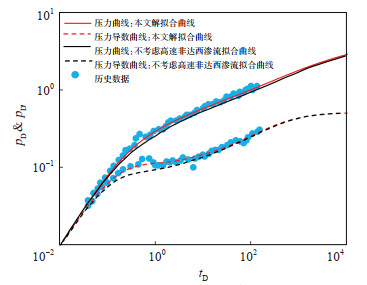
实例数据选取渤海疏松砂岩区块,地层渗透率为1 000 mD,其中X注水井经过长期水冲刷,注入压力由10.5 MPa下降至9 MPa左右,周围3个不同方向油井的含水率快速上升,含水率由86% 左右快速上升至95% 左右,提示大孔道发育(图 14)。采用本文模型对该井压降测试数据进行解释,设置3条大孔道发育,不考虑高速非达西渗流,早期突起拟合稍差,解释大孔道渗透率为7 500 mD;考虑高速非达西渗流,矿场数据得到较好拟合,解释3条大孔道角度分别为30°,115°及150°,长度分别为20.4 m,17.3 m及24.7 m,解释大孔道渗透率为65 300 mD,与示踪剂渗透率解释结果59 400 mD一致性高(图 15)。结合本文解释成果,实施矿场大孔道封堵作业,增油效果明显。矿场实例应用证明了本文模型的实用性,该模型可以实现大孔道的定量表征。
|
下载原图 图 14 实例井组生产动态曲线 Fig. 14 Well production dynamic curve of field case |
|
下载原图 图 15 实际数据拟合 Fig. 15 Interpretation of field data |
(1)结合线源、Laplace变换、数值离散及迭代计算方法构建考虑高速非达西渗流的多条大孔道注水直井试井解释模型,该方法可有效处理多条大孔道发育及大孔道内的高速非达西渗流,计算结果更加可靠。
(2)多条大孔道注水直井典型压力动态曲线可划分为井储、过渡段、双线性流、线性流、大孔道干扰及径向流等6个流动阶段,其中双线性流、线性流及大孔道干扰段的产生是大孔道识别的重要标志。
(3)大孔道数量及高速非达西渗流主要对压力解早期阶段产生影响。考虑高速非达西渗流后,早期压力及压力导数曲线均明显向上移动,大孔道内导流能力出现明显下降,沿大孔道无因次压力下降加快;高速非达西数的增大及最小渗透率比值的减小均会导致高速非达西渗流影响的加剧。随着大孔道数量的增多,双线性流、线性流及大孔道干扰段压力曲线明显下降,大孔道内高速非达西渗流的影响程度有所减小。
(4)将本文模型应用于渤海油田注水井试井解释,实际数据拟合效果较好,大孔道参数得到解释,证明了本文模型的实用性。
| [1] |
孙福街. 中国海上油田高效开发与提高采收率技术现状及展望. 中国海上油气, 2023, 35(5): 91-99. SUN Fujie. Status and prospects of efficient development and EOR technologies in China offshore oilfields. China Offshore Oil and Gas, 2023, 35(5): 91-99. |
| [2] |
刘仁静, 陆文明. 断块油藏注采耦合提高采收率机理及矿场实践. 岩性油气藏, 2024, 36(3): 180-188. LIU Renjing, LU Wenming. Mechanism and field practice of enhanced oil recovery by injection-production coupling in fault block reservoirs. Lithologic Reservoirs, 2024, 36(3): 180-188. DOI:10.12108/yxyqc.20240317 |
| [3] |
黄斌, 许瑞, 傅程, 等. 注采井间优势通道的多层次模糊识别方法. 岩性油气藏, 2018, 30(4): 105-112. HUANG Bin, XU Rui, FU Cheng, et al. Multi-level fuzzy identification method for interwell thief zone. Lithologic Reservoirs, 2018, 30(4): 105-112. DOI:10.12108/yxyqc.20180412 |
| [4] |
吴忠维, 崔传智, 杨勇, 等. 高含水期大孔道渗流特征及定量描述方法. 石油与天然气地质, 2018, 39(4): 839-844. WU Zhongwei, CUI Chuanzhi, YANG Yong, et al. Seepage characteristics and quantitative description of large pore pathways at high water cut stage. Oil & Gas Geology, 2018, 39(4): 839-844. |
| [5] |
张运来, 廖新武, 胡勇, 等. 海上稠油油田高含水期开发模式研究. 岩性油气藏, 2018, 30(4): 120-126. ZHANG Yunlai, LIAO Xinwu, HU Yong, et al. Development models for offshore heavy oil field in high water cut stage. Lithologic Reservoirs, 2018, 30(4): 120-126. DOI:10.12108/yxyqc.20180414 |
| [6] |
赵艳红, 姜汉桥, 李洪奇. 注水开发油田注水通道状态辨识及预测方法. 石油学报, 2021, 42(8): 1081-1090. ZHAO Yanhong, JIANG Hanqiao, LI Hongqi. Identification and predictions of water injectivity for water injection channels in water injection development oilfield. Acta Petrolei Sinica, 2021, 42(8): 1081-1090. |
| [7] |
李传亮, 王凤兰, 杜庆龙, 等. 砂岩油藏特高含水期的水驱特征. 岩性油气藏, 2021, 33(5): 163-171. LI Chuanliang, WANG Fenglan, DU Qinglong, et al. Water displacement rules of sandstone reservoirs at extra-high water-cut stage. Lithologic Reservoirs, 2021, 33(5): 163-171. DOI:10.12108/yxyqc.20210516 |
| [8] |
CLARK K K. Transient pressure testing of fractured water injection wells. Journal of Petroleum Technology, 1968, 20(6): 639-643. DOI:10.2118/1821-PA |
| [9] |
钟会影, 沈文霞, 藏秋缘, 等. 基于PEBI网格的考虑诱导裂缝的聚合物驱压力动态研究. 岩性油气藏, 2022, 34(3): 164-170. ZHONG Huiying, SHEN Wenxia, ZANG Qiuyuan, et al. Pressure transient of polymer flooding considering induced fractures based on PEBI grid. Lithologic Reservoirs, 2022, 34(3): 164-170. DOI:10.12108/yxyqc.20220315 |
| [10] |
ALAWAMI R L, TELLO GOMEZ A H, MORENO SIERRA F G, et al. Channel characterization in sandstone formation using pressure transient analysis: A practical overview to define geological attributes[R]. Dhahran, International Petroleum Technology Conference, 2024.
|
| [11] |
史有刚, 曾庆辉, 周晓俊. 大孔道试井理论解释模型. 石油钻采工艺, 2003, 25(3): 48-50. SHI Yougang, ZENG Qinghui, ZHOU Xiaojun. Interpreting model of larger pore well testing theory. Oil Drilling & Production Technology, 2003, 25(3): 48-50. |
| [12] |
李成勇, 程华, 蔡忠明, 等. 考虑不对称优势渗流通道试井解释数学模型. 大庆石油地质与开发, 2011, 30(2): 129-132. LI Chengyong, CHENG Hua, CAI Zhongming, et al. Well test interpretation mathematical model considering asymmetric preferential seepage channel. Petroleum Geology & Oilfield Development in Daqing, 2011, 30(2): 129-132. |
| [13] |
FENG Qihong, WANG Sen, ZHANG Wei, et al. Characterization of high-permeability streak in mature waterflooding reservoirs using pressure transient analysis. Journal of Petroleum Science and Engineering, 2013, 110: 55-65. DOI:10.1016/j.petrol.2013.08.042 |
| [14] |
谷建伟, 樊兆亚, 姜汉桥, 等. 一种新的注入井大孔道解释模型. 大庆石油地质与开发, 2013, 32(2): 49-54. GU Jianwei, FAN Zhaoya, JIANG Hanqiao, et al. Well test interpreting method of the polymer-flooded high capacity channel oil reservoir. Petroleum Geology & Oilfield Development in Daqing, 2013, 32(2): 49-54. |
| [15] |
曾杨, 康晓东, 谢晓庆, 等. 聚合物驱大孔道油藏试井解释方法. 大庆石油地质与开发, 2018, 37(2): 130-134. ZENG Yang, KANG Xiaodong, XIE Xiaoqing, et al. Well test interpreting method of the polymer flooded high capacity channel oil reservoir. Petroleum Geology & Oilfield Development in Daqing, 2018, 37(2): 130-134. |
| [16] |
WANG Yang, CHENG Shiqing, FENG Naichao, et al. Semianalytical modeling for water injection well in tight reservoir considering the variation of waterflood-induced fracture properties: Case studies in Changqing Oilfield, China. Journal of Petroleum Science and Engineering, 2017, 159: 740-753. |
| [17] |
姜瑞忠, 沈泽阳, 崔永正, 等. 双重介质低渗油藏斜井压力动态特征分析. 岩性油气藏, 2018, 30(6): 131-137. JIANG Ruizhong, SHEN Zeyang, CUI Yongzheng, et al. Dynamical characteristics of inclined well in dual medium low permeability reservoir. Lithologic Reservoirs, 2018, 30(6): 131-137. DOI:10.12108/yxyqc.20180616 |
| [18] |
VAN EVERDINGEN A F, HURST W. The application of the laplace transformation to flow problems in reservoirs. Journal of Petroleum Technology, 1949, 1(12): 305-324. |
| [19] |
郭晶晶, 徐耀宏, 杜佳, 等. 复合致密油藏变导流能力压裂井不稳定压力动态分析. 水动力学研究与进展A辑, 2023, 38(4): 612-620. GUO Jingjing, XU Yaohong, DU Jia, et al. Pressure transient analysis for fractured wells with variable conductivity in composite tight oil reservoirs. Chinese Journal Of Hydrodynamics, 2023, 38(4): 612-620. |
| [20] |
BARREE R D, CONWAY M W. Beyond beta factors: A complete model for Darcy, Forchheimer, and trans-Forchheimer flow in porous media[R]. Houston, SPE Annual Technical Conference and Exhibition, 2004.
|
| [21] |
BARREE R D, CONWAY M W. Multiphase non-Darcy flow in proppant packs[R]. Anaheim, SPE Annual Technical Conference and Exhibition, 2007.
|
| [22] |
崔永正, 姜瑞忠, 郜益华, 等. 空间变导流能力压裂井CO2驱试井分析. 岩性油气藏, 2020, 32(4): 172-180. CUI Yongzheng, JIANG Ruizhong, GAO Yihua, et al. Pressure transient analysis of hydraulic fractured vertical wells with variable conductivity for CO2 flooding. Lithologic Reservoirs, 2020, 32(4): 172-180. DOI:10.12108/yxyqc.20200418 |
| [23] |
徐有杰, 刘启国, 王瑞, 等. 复合油藏压裂水平井复杂裂缝分布压力动态特征. 岩性油气藏, 2019, 31(5): 161-168. XU Youjie, LIU Qiguo, WANG Rui, et al. Pressure transient of fractured horizontal well with complex fracture distribution in composite reservoir. Lithologic Reservoirs, 2019, 31(5): 161-168. DOI:10.12108/yxyqc.20190519 |
| [24] |
POE B D, SHAH P C, ELBEL J L. Pressure transient behavior of a finite-conductivity fractured well with spatially varying fracture properties[R]. Washington D.C., SPE Annual Technical Conference and Exhibition, 1992.
|
| [25] |
GUPPY K H, CINCO-LEY H, RAMEY H J, et al. Non-Darcy flow in wells with finite-conductivity vertical fractures. SPE Journal, 1982, 22: 681-698. |